
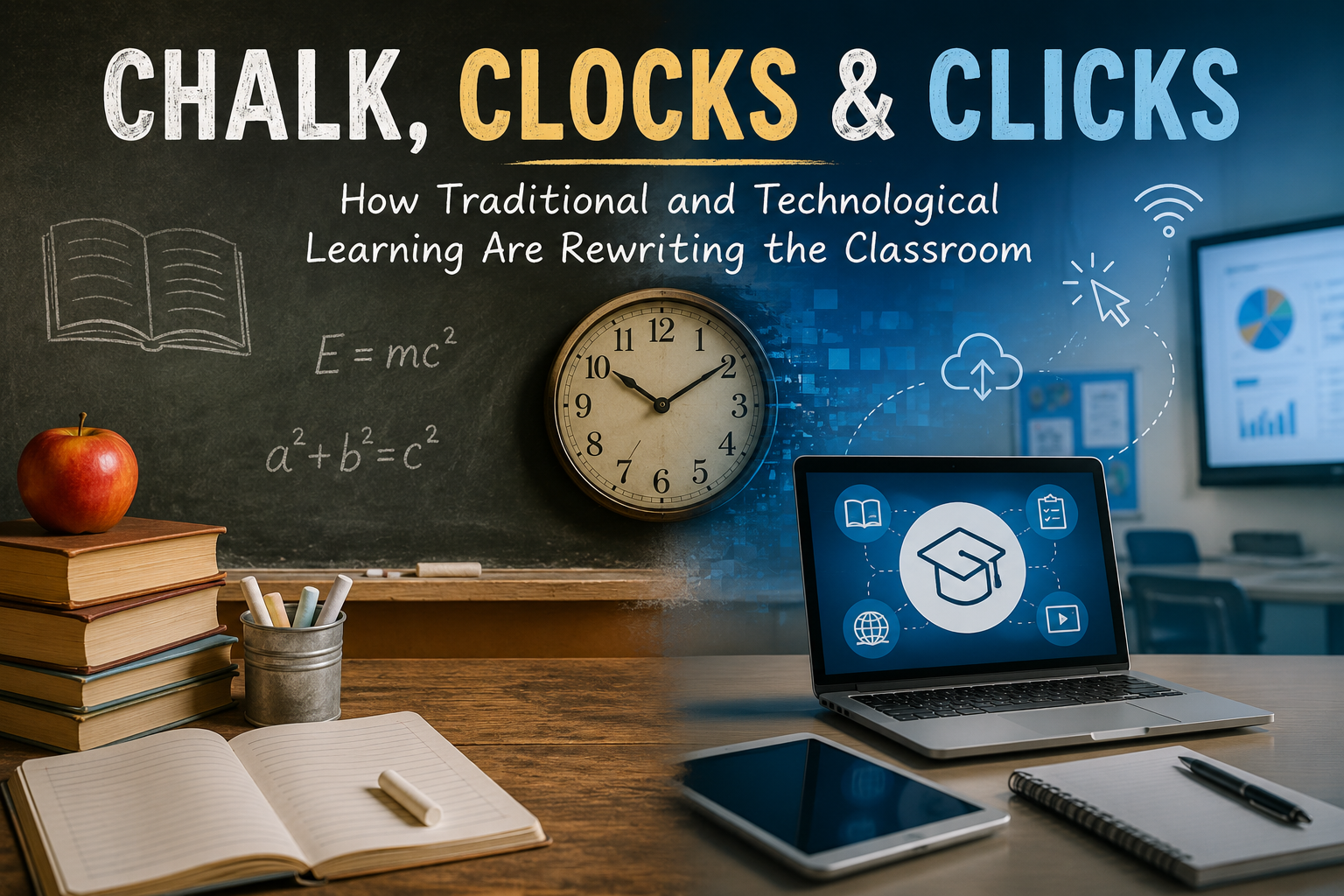
CHALK, CLOCKS & CLICKS How Traditional and Technological Learning Are Rewriting the Classroom
CHALK, CLOCKS & CLICKS
How Traditional and Technological Learning Are Rewriting the Classroom
Picture two classrooms standing side by side. In the first, chalk dust drifts through a shaft of morning light as a teacher writes today's lesson on a worn blackboard, and forty pairs of eyes follow the motion of her hand. In the second, screens glow, a stylus taps a digital whiteboard, and a lesson designed in the morning is already being replayed by a student halfway across the world by afternoon. Two worlds, one purpose: to pass knowledge from one mind to another. The story of education today is the story of how these two worlds collided — and how, out of that collision, something more powerful than either is beginning to emerge.
The Roots: Learning the Traditional Way
Long before projectors and platforms, learning was a human transaction — a teacher's voice, a learner's attention, and the discipline of repetition. The traditional classroom built its power on structure: a fixed timetable, a shared physical space, and a teacher who read not just the syllabus but the room — noticing confusion on a face before it turned into a question.
This model gave education something technology still struggles to replicate: presence. A raised eyebrow that told a student to try again. The quiet correction of posture during handwriting practice. The communal rhythm of reciting a poem together until it lived in memory rather than merely in notes. Traditional learning nurtured discipline, social bonding, and the slow, patient craft of mastery.
"Chalk teaches patience. The blackboard forgives nothing and rewards everything — every word must be earned by the hand that writes it."
Yet the same qualities that made traditional learning strong also revealed its limits. One teacher could only reach so many students at once. A lesson, once taught, could not be replayed. And a learner who missed a day, or a concept, often had no way back in except to wait for the cycle to return.
The Shift: Learning the Technological Way
Then came the disruption — not overnight, but wave after wave of it. Radio lessons. Educational television. Computer labs. And finally, the internet, which did not just add a new tool to the classroom; it dissolved the classroom's walls altogether. Technological learning promised what traditional learning never could: scale, speed, and endless repeatability.
A single well-designed video lesson can now teach a concept to one student or one million, without losing a word of clarity. An algorithm can notice, in seconds, that a learner is struggling with fractions and quietly serve up exactly the practice they need — something even the most attentive teacher, managing forty students at once, cannot always do in real time.
What technology brought to the table
● Access — a learner in a remote village can now reach a lecture recorded in a city thousands of kilometers away.
● Personalization — adaptive platforms tailor pace and difficulty to the individual, not the average.
● Repeatability — a confusing lesson can be replayed, paused, and rewound until it finally clicks.
● Data — teachers and institutions can now see, quantitatively, where a class is thriving and where it is quietly falling behind.
But technology, for all its speed, has its own blind spot. A screen does not notice when a learner's shoulders slump in discouragement. An app cannot sit beside a child and simply be present with them in a difficult moment. Motivation, mentorship, and the warmth of human encouragement remain stubbornly analog things.
The Emergence: Where the Two Worlds Meet
What is happening now is not a contest between chalkboard and touchscreen, but a quiet convergence. The most effective classrooms today do not choose one world over the other — they braid them together. A teacher still opens the lesson, sets the tone, and reads the room; then technology takes over to personalize, to practice, to reinforce, and to extend the lesson far beyond the walls of the room it started in.
This blended approach — sometimes called hybrid or blended learning — treats the teacher as a guide and technology as an amplifier. The teacher's judgment decides what matters; the technology's reach decides how far it travels. Homework becomes interactive. Assessment becomes instant. And a struggling learner is no longer left waiting for the next term to catch up — help arrives the moment it is needed.
"The future of learning is not human versus machine. It is human, plus machine, minus the limits either one carried alone."
For institutions training the next generation of professionals — ICT technicians, teachers, community workers — this convergence matters enormously. A student who learns a concept from a teacher's explanation, practices it on a simulation, and is finally assessed through a well-designed digital exam, is not just being taught. They are being prepared for a world where both the chalkboard and the keyboard will remain tools of their trade.
Conclusion: Two Paths, One Destination
Traditional learning gave education its soul — discipline, presence, and the irreplaceable warmth of a teacher who cares. Technological learning is giving education its wings — reach, speed, and the ability to meet every learner exactly where they are. Neither path is obsolete; each is incomplete without the other.
The emergence we are witnessing is not the death of the classroom, nor the triumph of the screen. It is the birth of something new: a learning ecosystem where chalk dust and computer code exist on the same page, quietly working toward the same old goal — to help a mind reach a little further than it could reach alone.
— End —